Showing posts with label economy. Show all posts
Showing posts with label economy. Show all posts
Friday, August 22, 2008
Financial crises
Yesterday the price of oil jumped $5 per barrel. That means our "reprieve" from high gas prices is likely to end soon. I can't believe I even consider $3.39 per gallon for gas cheap, but I guess that's how they get us. A recent columnist in Newsweek reminded me that it's not cheap and that riding my bike to work is still a pretty good investment of my energy. Course soccer moms don't necessarily reflect the challenges of CMCA clients but truly there are alternatives to individual automobiles that pose solutions that all of us should consider. The bus system in Columbia seems to work for a lot of college students but I haven't heard a lot of praise from folks who are just trying to get to work on time. But it is something we can build on. Our more rural communities don't even have a kernel of a transportation system. Walking, biking, and carpooling seem to represent the best options for gasoline conservation at this point. But I digress. The NPR story that alerted me to the rise in the cost of oil also spouted off a litany of additional costs that we should expect to inflate. Primarily food, clothing, and just about anything one would use U.S. currency to purchase. Teri Roberts, CMCA Financial Education Coordinator, sent me this resource to help consider how to deal with these rising costs, avoid crises, and help our neighbors to deal with the crises they're already experiencing. It isn't much but we're all going to have to figure out how to get through this together.

Wednesday, April 2, 2008
Inflation Hits the Poor Hardest
I realize how difficult it is to keep up with a blog each time a month slips by and I realize I haven't posted anything!
Today's entry is easy. We are all feeling the pinch of rising costs (it shouldn't cost $50 bucks to fill the gas tank of a HONDA!) but who feels it the most? You guessed it, those who can least afford an increase of bread, milk, and gas. What's worse, the price for these staples is going up faster than the price of items that we can cut back on like cars or restaurant meals. This article from the front page of the Washington Post a couple of weeks ago provides some excellent food for thought. This article was brought to my attention by the Community Action Partnership, our national Community Action presence. They are doing a great job of bringing the reality of poverty to our national leaders.
For those of you who have been following my school board exploits, you might wonder how I can feel good recommending a tax levy increase in Columbia despite the situation described above. First, I don't feel good about it. Ultimately though, education is one of the best ways to mitigate the effect of recession. A strong public education system provides an important draw to employers who are looking for qualified employees, prepares students for higher paying jobs and post-secondary education options, and increases the quality of life for everyone in the community. Supporting education is the right thing to do for our economy and everyone effected by the current economic climate.
Today's entry is easy. We are all feeling the pinch of rising costs (it shouldn't cost $50 bucks to fill the gas tank of a HONDA!) but who feels it the most? You guessed it, those who can least afford an increase of bread, milk, and gas. What's worse, the price for these staples is going up faster than the price of items that we can cut back on like cars or restaurant meals. This article from the front page of the Washington Post a couple of weeks ago provides some excellent food for thought. This article was brought to my attention by the Community Action Partnership, our national Community Action presence. They are doing a great job of bringing the reality of poverty to our national leaders.
For those of you who have been following my school board exploits, you might wonder how I can feel good recommending a tax levy increase in Columbia despite the situation described above. First, I don't feel good about it. Ultimately though, education is one of the best ways to mitigate the effect of recession. A strong public education system provides an important draw to employers who are looking for qualified employees, prepares students for higher paying jobs and post-secondary education options, and increases the quality of life for everyone in the community. Supporting education is the right thing to do for our economy and everyone effected by the current economic climate.
Thursday, January 31, 2008
Economic Stimulus
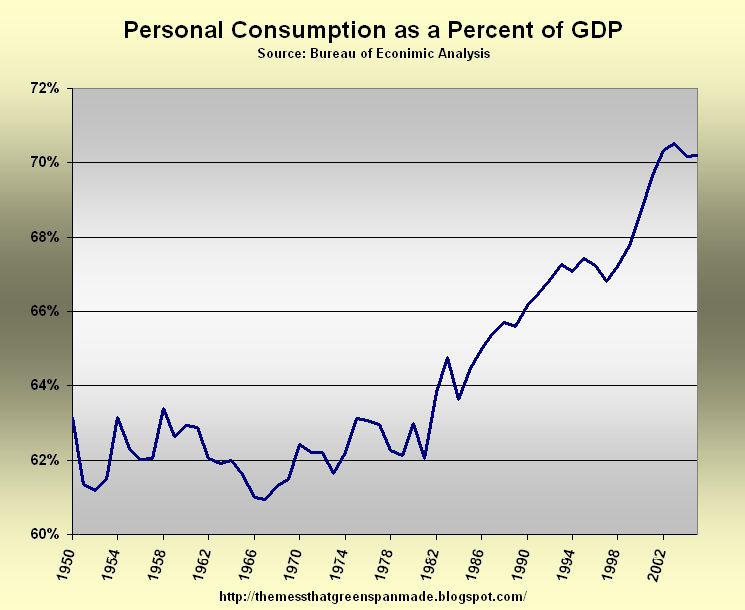
I get the economic stimulus package Congress is debating. Consumer spending is a ridiculously large portion of the Gross Domestic Product, the number people like to throw around to indicate the relative economic health of countries. Over 70% of the dollars traded in the United States come from consumer spending. So you pump $146 BILLION dollars into people's pockets, suddenly there's a bunch of those 50" t.v.s leaving Best Buy, and the economic heartbeat of our country gets resuscitated. It makes sense. But to me it's a sick kind of sense. We're injecting adrenaline into a patient that needs brain surgery. I've got two problems with the discussion. 1. The House version of the stimulus package gives a check to households making up to $150,000 and the draft version being debated in the Senate is for households making twice that much. I don't know, that just sounds wrong. Personally, I'm going to use the money to pay down credit cards bills. That's consumption that's already taken place, not the new consumption needed to keep the boat afloat. I'd rather see the cap on household income at $50 or $60 thousand and for about twice as much per household than is reflected in the House version (around $1,600 for a family of four). Two or three grand in a household that make up to just past living wages would buy a lot of stuff. But still, those families carry a tremendous amount of debt and I'd have to advise that they use the windfall to pay that debt down. Which leads me to my second problem with the economic stimulus discussion. It seems to me that rabid consumerism may have something to do with the problem. We have established an expectation that we should all get all the stuff we can while we can, debt be damned, as if there is no consequence for the trillions of dollars that are being spent on credit. This is money that doesn't exist. It's no surprise that Congress is pushing a package that legitimizes our every desire when they've been spending trillions of imaginary dollars for years. Guess who the creditor for the U.S. is . . . China. No kidding. But I digress. Seems to me our government ought to be telling us to tighten our belts a little, drive our cars a little less, perhaps even get out of our houses and help out our neighbors when they're in need. I know I'm all over the place on this one but imagine what $146 billion dollars could buy if only we were thinking about an investment in the future rather than a quick fix. Heck, just $7 billion added to the Head Start allocation would fund Head Start for every eligible child in the country. We could put countless thousands through college, draw the best teachers to inner-city schools, create venture capital for a whole new breed of entrepreneurs, create birth funds that virtually guarantee that no child would need to live in poverty, or link even the most rural parts of our country with broadband internet access (the U.S. is like 33rd in overall broadband coverage) , creating commerce opportunities we can only dream of.
I could go on and on. There are lots of things better to invest in than just telling the public "everything is okay, just keep spending money." Like I said though, I really do get the concept. It just leaves me feeling a little queasy and shallow. Anyway, I think I'll go think of other ways to spend my money.
I could go on and on. There are lots of things better to invest in than just telling the public "everything is okay, just keep spending money." Like I said though, I really do get the concept. It just leaves me feeling a little queasy and shallow. Anyway, I think I'll go think of other ways to spend my money.
Subscribe to:
Posts (Atom)